 English
 中文简体
中文简体 русский
 عربى
عربى

Content
- 1 What Is a Fusion Pipe Machine and Why It Matters
- 2 How the Fusion Process Actually Works
- 3 Types of Fusion Pipe Machines by Operating Range
- 4 The Welding Machine Pipe Clamp: Why Alignment Is Everything
- 5 Critical Fusion Parameters and Their Numerical Targets
- 6 Electrofusion: When a Separate Fusion Pipe Machine Is Not Practical
- 7 Common Fusion Defects, Causes, and Prevention
- 8 Maintaining a Fusion Pipe Machine for Long-Term Accuracy
- 9 How to Select the Right Fusion Pipe Machine for Your Project
- 10 Safety Practices for Fusion Pipe Machine Operations
- 11 Butt Fusion vs Socket Fusion vs Electrofusion: Choosing the Method
- 12 Industry Applications and Performance Expectations
What Is a Fusion Pipe Machine and Why It Matters
A fusion pipe machine is a thermoplastic welding system that joins polyethylene (PE), polypropylene (PP), or PVDF piping by melting mating surfaces together under precisely controlled heat and pressure — producing joints that routinely reach 100% of the parent-pipe tensile strength. Unlike mechanical couplings that rely on seals and clamps, a properly executed fusion joint becomes monolithic: there are no gaskets to degrade, no threads to strip, and no leak paths to manage.
Three fusion methods cover virtually every field application: butt fusion, which heats pipe ends against a flat heater plate; socket fusion, which melts spigot and socket simultaneously; and electrofusion, which uses wire coils embedded in a coupler fitting. Each method demands the same core hardware: a heat source, a welding machine pipe clamp to hold pipe ends in axial alignment, and a means of applying and releasing fusion pressure at the right moment. Getting any of those three variables wrong — temperature, alignment, or pressure — produces a cold joint, inclusion, or void that fails long before the pipe itself would.
How the Fusion Process Actually Works
Thermoplastic fusion is a diffusion-bonding process. When two PE surfaces are held in contact above the material's crystalline melt temperature — typically 200 °C to 230 °C for PE 100 — polymer chains from each face inter-diffuse across the interface. Once the material cools below the crystallization temperature, those chains lock together into a single crystalline network. The joint boundary becomes invisible at the molecular level.
Key Process Phases
- Phase 1 — Facing: A rotating trimmer square-cuts both pipe ends to remove oxidation and create perfectly planar, parallel surfaces.
- Phase 2 — Heating: The heater plate (set to ±2 °C of the target) contacts both faces under low drag pressure until a uniform melt bead of the correct width forms.
- Phase 3 — Heater removal: The machine opens, the plate is withdrawn, and the gap time between plate removal and joint closure must be under 4 seconds for pipes above DN 250 — any longer allows the melt surface to cool and skin over.
- Phase 4 — Fusion: Clamps close at the specified fusion pressure, forcing melt faces together. A double-roll bead forms and the joint cools under pressure for the full cooling time.
- Phase 5 — Cooling: Pressure is held throughout. For a 315 mm SDR 11 pipe, minimum cooling time under load is approximately 22 minutes at 20 °C ambient, rising to 35+ minutes if ambient temperature drops below 5 °C.
The welding machine pipe clamp is what makes phases 3 and 4 possible at industrial scale. Without a clamp that holds axial concentricity to within 0.5 mm, the melt beads will not meet evenly, and the resulting joint will have one-sided cold areas that can propagate as cracks under pressure cycling.
Types of Fusion Pipe Machines by Operating Range
Not every fusion pipe machine handles every pipe size. Manufacturers segment their product lines by pipe diameter, with machine frame design, hydraulic cylinder bore, and clamp jaw geometry all engineered around a specific range. Choosing an undersized machine for a large-diameter job produces inadequate fusion pressure; choosing an oversized machine for small-bore work makes precise low-force control difficult.
| Machine Class | Pipe OD Range | Typical Hydraulic Force | Common Applications | Frame Style |
|---|---|---|---|---|
| Compact Benchtop | 20 – 125 mm | up to 5 kN | Gas service, conduit, laboratory lines | Manual screw or hand-pump hydraulic |
| Mid-Range Field | 90 – 315 mm | 5 – 35 kN | Municipal water, irrigation mains, industrial process | Hydraulic unit, wheeled or skid |
| Heavy-Duty | 250 – 630 mm | 35 – 160 kN | Transmission mains, sewer forcemains | Tracked crawler, separate power pack |
| Large Diameter Specialist | 500 – 1600 mm | 160 – 600 kN | Hydropower penstocks, offshore outfalls | Excavator-mounted or stand-alone gantry |
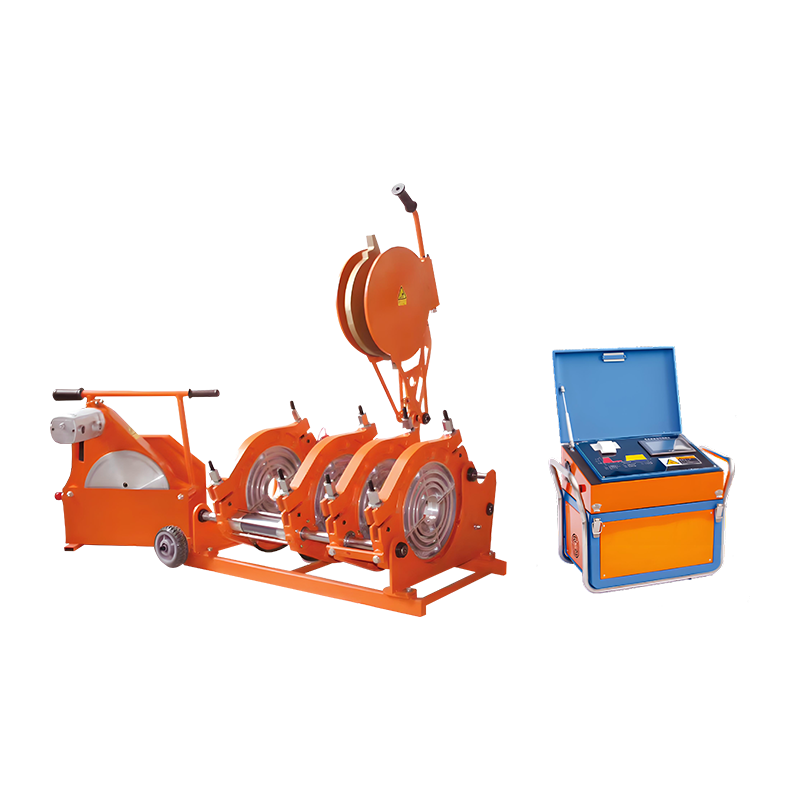
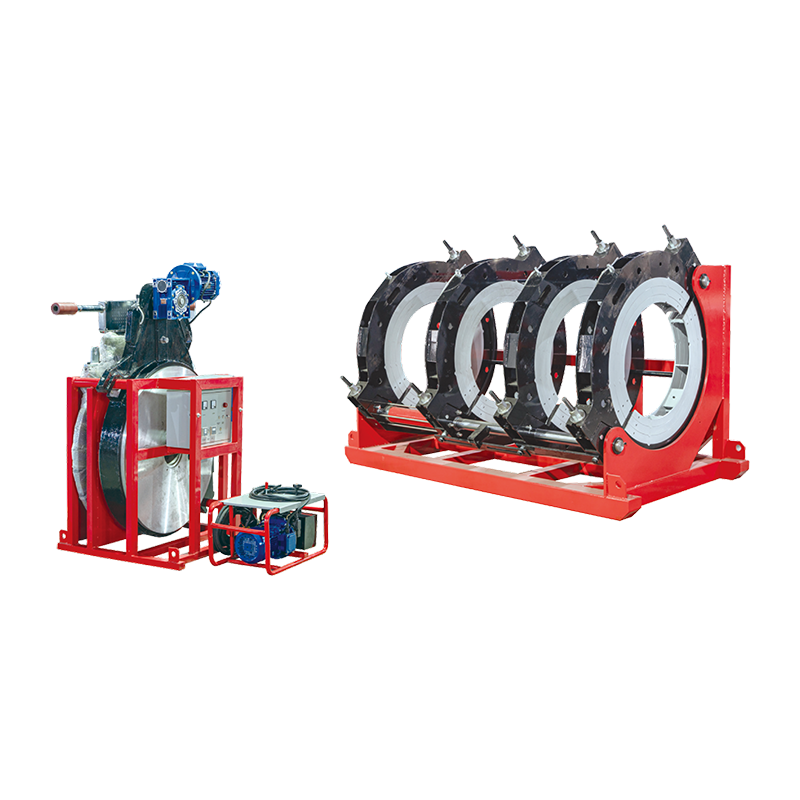
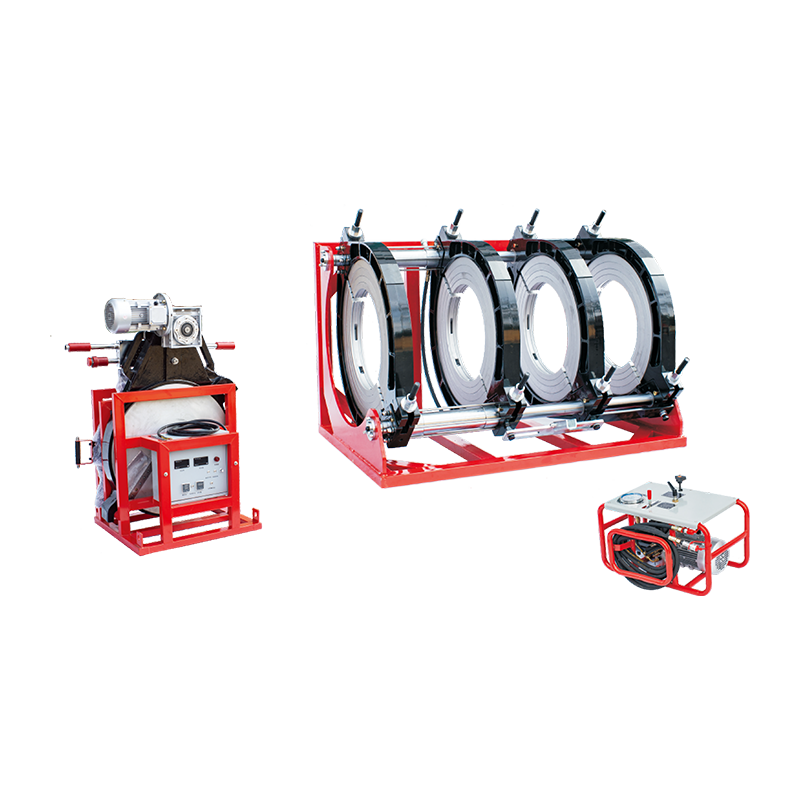
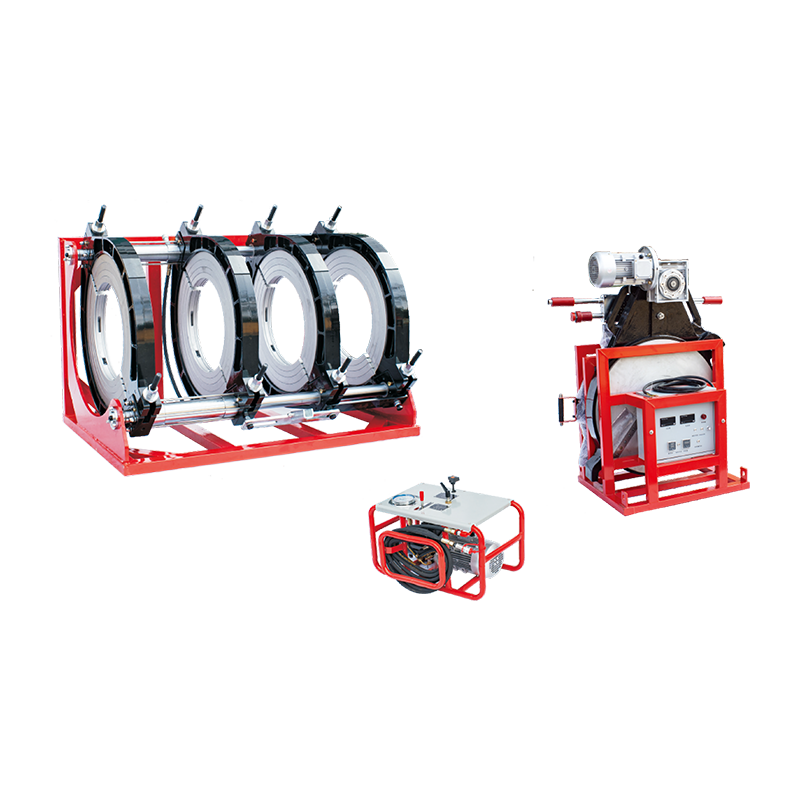
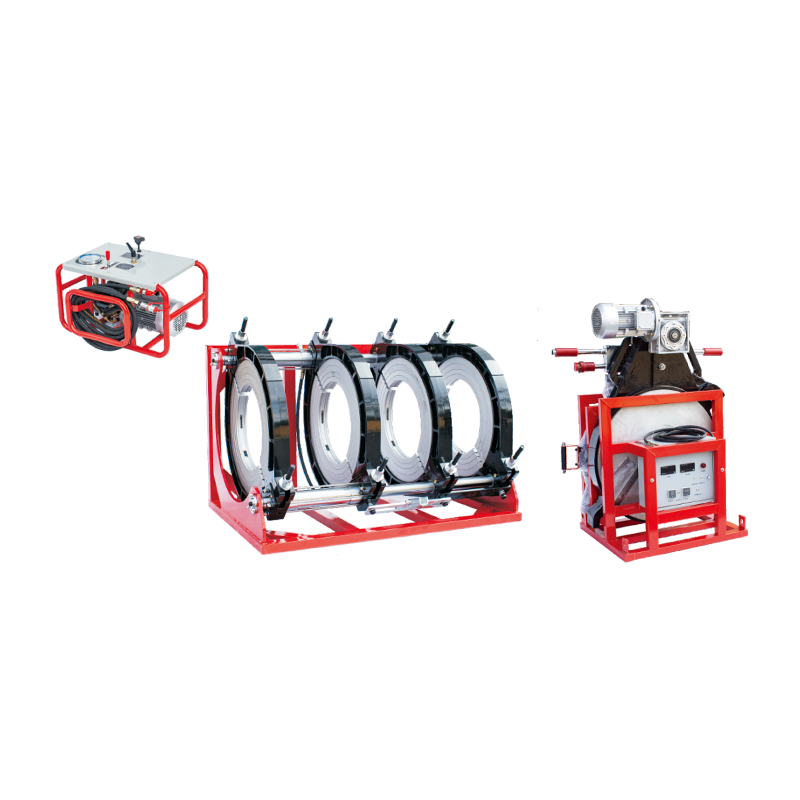
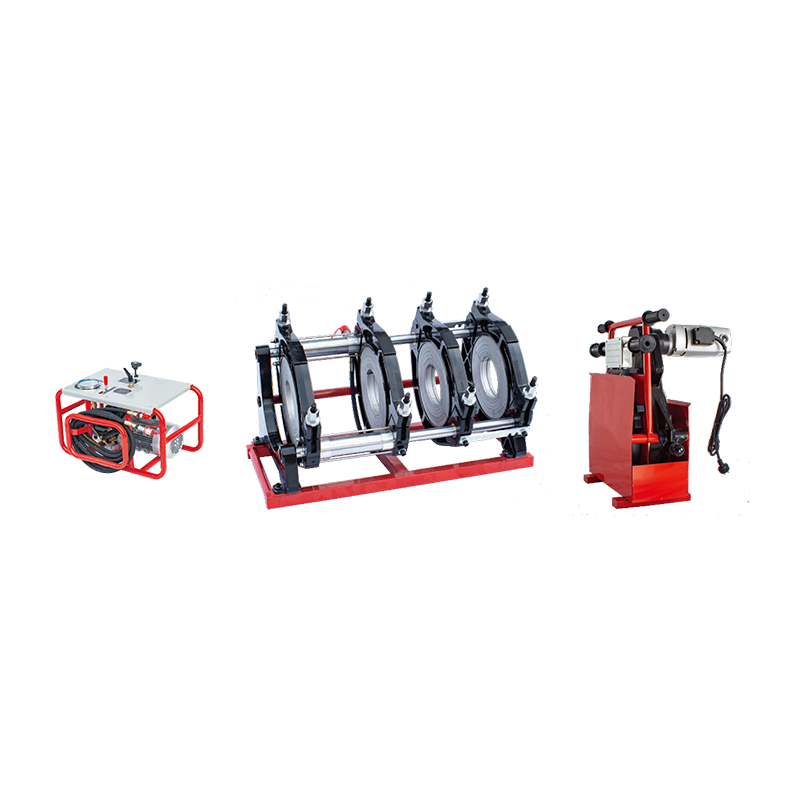
For the mid-range field class, the welding machine pipe clamp is typically a four-jaw split-ring design that indexes into grooves on the fusion machine's carriage rail. Each jaw is independently adjustable so that oval or slightly out-of-round pipe — common in storage-stressed HDPE coils — can be rounded before facing begins.

The Welding Machine Pipe Clamp: Why Alignment Is Everything
The welding machine pipe clamp does three jobs simultaneously: it holds pipe ends on the machine's central axis, resists the axial forces generated during fusion pressure application, and allows smooth, low-friction travel for the carriage so that heating drag pressure can be set and held accurately. Failure in any of those roles produces a defective joint.
Clamp Jaw Materials and Configurations
Most clamps intended for PE and PP pipe use ductile iron or cast aluminum jaws with a replaceable polyurethane or nylon liner. The liner prevents jaw marks from embedding into the pipe wall, which would create stress concentrations near the joint. For very large diameter work (above 630 mm), some manufacturers shift to segmented steel jaw sets that bolt together around the pipe circumference.
Clamp-to-clamp misalignment tolerance matters more than most operators realize. Studies of field joint failures frequently cite lateral offset greater than 10% of wall thickness as the primary defect origin. For a 315 mm SDR 11 pipe with a 28.6 mm wall, that means an offset limit of roughly 2.9 mm — achievable easily with a properly maintained clamp but difficult to achieve by hand-holding pipe on a simple bench setup.
Clamp Integration with CNC-Controlled Fusion Machines
Modern data-logging fusion pipe machines integrate clamp position feedback into the control loop. Linear encoders on the carriage rails measure travel in real time, allowing the machine to calculate instantaneous fusion pressure from the hydraulic cylinder area and measured cylinder pressure, then log it against elapsed time. The output — a pressure-versus-time fusion trace — becomes a permanent quality record for the joint. If the trace deviates from the specification envelope, the machine flags the weld immediately. This closed-loop approach replaces operator judgment for the pressure control function, though the operator still sets and verifies clamp grip, checks facing quality visually, and monitors ambient conditions.
Clamp Selection Checklist
- Confirm the clamp jaw set matches the pipe's actual OD — not the nominal size. SDR series pipes in the same DN can differ by several millimeters across resin grades.
- Check liner condition before every shift. Worn liners allow pipe to slip axially during fusion pressure application, causing bead asymmetry.
- Verify that the clamp's rated force exceeds the maximum fusion pressure for the largest pipe in the job. For a 450 mm SDR 11 PE 100 pipe, fusion force is approximately 68 kN; the clamp and its mounting to the carriage must handle that load without deflection.
- Inspect jaw pivot pins and locking mechanisms for wear. A loose pivot allows the jaw to rotate slightly under load, shifting the pipe off-axis.
- If electrofusion is being performed after butt fusion on the same machine carriage, confirm the clamp is designed to hold fittings as well as plain pipe ends.
Critical Fusion Parameters and Their Numerical Targets
Every reputable fusion standard — whether DVS 2207-1, EN 12007, or ASTM F2620 — shares the same underlying parameter framework. What changes between standards is the exact numerical value for specific resin grades and pipe dimensions. The table below shows representative targets for PE 100 butt fusion at 20 °C ambient using a fusion pipe machine with a hydraulic power unit:
| Pipe OD (mm) | Heater Temp (°C) | Drag Pressure (bar) | Heating Time (s) | Max Change-over (s) | Min Cooling (min) |
|---|---|---|---|---|---|
| 110 | 210 ± 10 | Calculated from wall area | 80 – 100 | 5 | 8 |
| 200 | 210 ± 10 | Calculated from wall area | 140 – 180 | 6 | 14 |
| 315 | 210 ± 10 | Calculated from wall area | 190 – 240 | 6 | 22 |
| 500 | 210 ± 10 | Calculated from wall area | 280 – 350 | 8 | 36 |
| 630 | 210 ± 10 | Calculated from wall area | 340 – 420 | 8 | 45 |
The drag pressure shown as "Calculated from wall area" in the table above means operators must compute the specific hydraulic pressure setting for their machine based on the cylinder bore and the formula: P_cylinder = (0.15 N/mm² × Pipe end area) / Cylinder area. Every machine will have a slightly different hydraulic cylinder diameter, so fusion pressure tables are always machine-specific. This is why welding machine pipe clamp and machine must be treated as a matched system — changing the carriage or hydraulic unit without recalculating the pressure settings invalidates the procedure.
Effect of Ambient Temperature on Cooling Time
Cooling time is one of the most frequently shortcut parameters on real job sites. The consequence of premature clamp release is a joint that appears sound but has residual stress built into the bead that leads to slow crack growth over years of service. The adjustment factor for temperature is significant: at 0 °C ambient, cooling time for a 315 mm SDR 11 pipe increases to approximately 32 minutes, compared to 22 minutes at 20 °C. At 35 °C ambient, the time decreases to around 18 minutes because convective cooling accelerates.
Electrofusion: When a Separate Fusion Pipe Machine Is Not Practical
Electrofusion is the preferred method when butt fusion is impractical — typically in confined trenches, tight bends, or repair scenarios where pulling a full fusion pipe machine into position is not possible. The process uses fittings with embedded resistance wire coils. A dedicated electrofusion controller delivers a precisely controlled voltage (typically 8V to 48V DC) for a fitting-specific fusion time, using barcode-scan data to set the parameters automatically.
Pipe Preparation
Scrape the pipe OD over the full socket insertion zone to a depth of 0.2 – 0.5 mm to remove the oxidized skin. This is the single most critical step — surface oxidation prevents polymer chain diffusion. Use a rotary scraper sized exactly to the pipe OD, not a knife or abrasive cloth.
Alignment Clamp
An alignment clamp or pipe support bracket must hold the pipe ends collinear with the fitting axis during the full fusion cycle and cool-down. Movement during fusion disrupts the melt zone and creates a porous interface. Dedicated electrofusion alignment clamps are simpler than butt fusion machines but perform the same fundamental function as a welding machine pipe clamp.
Fusion and Cooling
Once the controller completes the fusion cycle, the fitting's indicator pins visibly protrude — confirming that internal pressure built up (melt expanded) as expected. The assembly must then cool for a fitting-specified period, typically 20 to 60 minutes depending on fitting size, before any load is applied.
Data Logging
Modern electrofusion controllers store a complete log of every joint: fitting barcode, operator ID, ambient temperature, fusion voltage, fusion time, and date/time stamp. This traceability record is routinely required for gas distribution, potable water, and industrial pipeline projects. The machine essentially removes parameter-setting risk from the operator for the fusion energy side of the process.

Common Fusion Defects, Causes, and Prevention
Understanding defect mechanisms is as important as knowing the correct procedure. The following describes the most frequently encountered fusion joint defects and what drives them, based on field failure analysis data from water and gas distribution projects.
Cold Fusion (Insufficient Melt Depth)
Caused by inadequate heating time, low heater plate temperature, or too-rapid change-over that allows the surface to re-solidify before the pipes are brought together. The joint achieves partial bond at surface asperities but leaves un-bonded zones throughout the cross-section. Hydrostatic burst testing typically shows failure at 40% to 60% of the expected failure pressure. Prevention: verify heater plate temperature with a calibrated contact thermometer before each weld session; use a timer rather than visual bead judgment alone.
Axial Misalignment (Step at Bead)
Results from worn or incorrectly sized welding machine pipe clamp jaws, or from using the wrong reduction insert for the pipe OD. A visible step at the weld bead creates a stress concentration that under fatigue loading initiates cracking at service pressures well below the rated working pressure. Even a 2 mm offset in a 110 mm SDR 11 pipe reduces fatigue life by approximately 40% in cyclic pressure tests. Prevention: inspect and replace clamp liners on a scheduled basis; measure pipe OD before selecting jaw inserts.
Inclusion / Contamination
Dirt, moisture, pipe shavings, or heater plate contamination trapped in the melt interface prevents polymer diffusion across that zone. Even a thin film of moisture can create a steam-void that shows as a circular dark inclusion on ultrasonic inspection. Prevention: keep the facing area and heater plate surface clean; wipe the plate with a clean dry cloth, never with solvents that leave residue; and always re-face if the pipe end is touched after facing.
Premature Clamp Release
Releasing the fusion pipe machine clamp before the pipe has cooled below the crystallization temperature allows the bead to deform under residual melt stress. The external bead may look normal but the internal structure has micro-voids and reduced crystallinity density. Over a service life of 30–50 years under sustained pressure, this internal porosity becomes a slow-crack initiation site. Prevention: use a mechanical timer or machine-automated cooling timer, never rely on operator judgment.
Excessive Fusion Pressure
Too-high fusion pressure squeezes molten material out of the interface before adequate diffusion occurs, producing a thin bond with an oversized bead but inadequate cross-linked structure. Excess bead material in the pipe bore also increases flow resistance. This defect often results from using an incorrect pressure table — for example, applying the pressure setting from a larger machine to a smaller one without recalculating for the difference in cylinder bore diameter.
Maintaining a Fusion Pipe Machine for Long-Term Accuracy
A fusion pipe machine is a precision instrument. Its heater plate thermostat, hydraulic cylinder seals, carriage rails, and welding machine pipe clamp jaw surfaces all experience wear and drift that can silently degrade joint quality long before any mechanical failure becomes obvious. Structured maintenance prevents that degradation.
Daily Checks
- Verify heater plate temperature at operating setpoint using a calibrated contact or infrared thermometer — not the machine's built-in display alone.
- Clean heater plate PTFE coating with a dry, lint-free cloth; inspect for scratches or flaking that could transfer contamination to the melt face.
- Check hydraulic oil level; low oil level causes pressure surges and inconsistent force delivery.
- Inspect clamp jaw liners for wear marks, cracks, or embedded pipe debris.
- Confirm the facing trimmer blades are sharp — a dull blade leaves torn rather than cleanly cut pipe ends, which do not fuse correctly.
Monthly Service
- Lubricate carriage rails and lead screw with the machine-manufacturer's specified lubricant. Over-lubricating with the wrong grease attracts pipe shavings that then become inclusions.
- Check hydraulic pressure gauge calibration against a known reference; drift of more than 2% warrants recalibration or gauge replacement.
- Test clamp jaw closure force with a load cell to verify that clamping force meets the manufacturer's minimum holding specification for the largest jaw set.
- Inspect electrical connections on data-logging units for corrosion, especially in high-humidity trench environments.
Annual Overhaul
- Replace hydraulic cylinder seals as a set; individual seal replacement after a single leak extends overhaul intervals and risks cylinder bore scoring.
- Send the heater plate thermocouple for independent calibration; accumulated drift in the temperature sensor is the most common cause of low-grade cold fusion that passes visual inspection but fails on long-term hydrostatic testing.
- Replace all carriage bearing blocks if linear play exceeds 0.3 mm measured at the jaw mounting face.
- Flush and replace hydraulic fluid; contaminated fluid increases internal leakage past cylinder seals, reducing effective fusion force.

How to Select the Right Fusion Pipe Machine for Your Project
Selecting a fusion pipe machine is not simply a matter of matching the largest pipe OD on the job. Project conditions, pipe material, work site access, power availability, and quality-documentation requirements all drive the specification. The following framework addresses each factor systematically.
- Define the full pipe OD range. A machine that handles 90–315 mm may be adequate for most joints but will not accommodate any 400 mm fittings that appear at valve stations. Either include those joints in the machine spec or plan for a supplemental machine or electrofusion solution.
- Assess hydraulic power availability. For remote sites without reliable generator access, consider machines with battery-powered hydraulic units or manual screw-drive designs for smaller pipe ranges. Voltage fluctuation from undersized generators damages electronic control boards in data-logging machines.
- Evaluate access and portability. A 630 mm machine weighs over 800 kg without the power pack. In trench depths below 3 m with limited working width, a machine that cannot be crane-lifted in one lift as a single unit will require on-site assembly — adding time and introducing additional alignment risks with the welding machine pipe clamp jaw-to-frame interface.
- Confirm pipe material compatibility. PE 100 RC (Resistant to Crack), PP-R, PVDF, and PA 12 all require different heater plate temperatures and different fusion pressure calculations based on their MFR (melt flow rate). Machines sold for PE may not come with PVDF-rated heater plates or the correct software fusion tables.
- Specify data-logging requirements early. If the project owner requires joint-by-joint traceability with digital fusion traces, the machine must have an integrated data logger with export capability. Retrofitting data logging to a basic hydraulic machine after purchase is rarely straightforward and may not satisfy documentation requirements.
- Verify the clamp jaw range. Machines rated to a certain OD may only include jaw sets for a subset of that range as standard equipment. Reduction inserts for small-end diameters and extended jaw sets for the top of the range are often extra-cost items. Confirm the full jaw set is included before finalizing the machine order.
- Check spare parts availability. PTFE heater plate replacement, trimmer blades, hydraulic seals, and clamp liner sets should be available locally or with short lead times. A fusion program that stops because a trimmer blade is on a 12-week import schedule has severe project impact.
Safety Practices for Fusion Pipe Machine Operations
Fusion work involves sustained exposure to surfaces at 210 °C or above, significant hydraulic forces in excess of 100 kN on larger machines, and the physical demands of handling heavy pipe and equipment in confined trench environments. The following practices address the most significant hazard categories.
Burn and Heat Hazards
- Always use heat-resistant gloves when handling the heater plate. The PTFE coating makes the hazard non-obvious since the plate can be touched briefly without immediate burning, masking the severity of the temperature.
- Position the heater plate storage stand downwind from operators during the change-over phase. A 210 °C plate radiates significant heat and can cause corneal damage from proximity exposure.
- Never lay the heater plate flat on soil or organic material. Contact with dry vegetation can ignite if the plate is left unattended.
Hydraulic Force Hazards
- Keep hands clear of the carriage travel zone during pressure application. Fusion machines generate forces that will crush hands or feet instantaneously — proximity guards should remain in place during automatic cycle operation.
- Never use the machine to force misaligned or bowed pipe ends into position. The fusion machine is a precision welding tool, not a pipe straightener; applying lateral force to the hydraulic carriage to align pipe ends that should be supported externally can fracture the carriage frame.
- Inspect hydraulic hose condition before each shift. A hydraulic burst at 200 bar working pressure can cause injection injuries that are not immediately apparent but are medically serious.
Confined Space and Trench Safety
- When operating a fusion pipe machine inside an excavation, confirm trench wall shoring meets local requirements before lowering equipment. Machine weight and the vibration from hydraulic operation can destabilize inadequately shored walls.
- Provide a clear escape route at all times. A fusion cycle that takes 30+ minutes for cooling cannot be safely abandoned mid-cycle, but operators must be able to exit if trench conditions deteriorate.
- Monitor air quality in deep trenches for methane, CO, or low oxygen levels, particularly when welding near existing gas infrastructure.
Butt Fusion vs Socket Fusion vs Electrofusion: Choosing the Method
Each fusion method has a domain where it outperforms the others. Experienced pipeline contractors typically carry both a butt fusion pipe machine and an electrofusion controller, using each where it is most efficient.
| Criterion | Butt Fusion | Socket Fusion | Electrofusion |
|---|---|---|---|
| Suitable OD range | 20 mm – 1600+ mm | 16 mm – 160 mm | 20 mm – 1200 mm |
| Equipment cost | Medium to very high | Low | Low (controller) + fitting cost |
| Joint material cost | Low (no fitting required) | Medium (socket fittings) | High (EF fittings are expensive) |
| Confined space suitability | Poor – machine needs axial clearance | Moderate | Excellent |
| Operator skill dependency | High (automated machines reduce this) | Very high | Low (machine controls parameters) |
| Weld traceability | Optional (with data-logging machine) | Rarely available | Standard on all modern controllers |
| Production rate (joints/day) | High for straight-run pipe | High for small-bore networks | Lower due to fitting cost and cooling |
For straight-run water or gas mains in open trench conditions, butt fusion with a properly maintained fusion pipe machine and quality welding machine pipe clamp system will always deliver the lowest installed cost per joint. Electrofusion becomes the economically rational choice for connections at valves, service tees, and repair couplings where butt machine access is restricted, despite the higher fitting cost.
Industry Applications and Performance Expectations
Fusion-welded PE pipe systems installed with a correctly operated fusion pipe machine have demonstrated service lives in excess of 50 years under continuous pressure in water and gas distribution networks. The following describes performance data across the most common application sectors.
PE 100 pipe fused at the correct parameters and pressure-tested to 1.5 times working pressure before commissioning has a measured leak rate in service that is consistently below 0.1 liter per km per hour per meter of pressure head, versus 5–20 liters for equivalent aged PVC systems with mechanical joints. The whole-pipe integrity of fusion joints is the primary driver of these numbers — every mechanical joint is a potential leak point, and fusion systems have essentially zero mechanical joints in the straight run.
PE pipe fused with a calibrated fusion pipe machine has been used for gas distribution at pressures up to 10 bar in medium-pressure networks. The material's resistance to soil movement — PE can accommodate longitudinal strain up to 5% before yielding, versus near-zero for grey iron or steel — makes it the dominant replacement choice for aging cast iron mains in urban environments.
Fused PVDF (polyvinylidene fluoride) piping for semiconductor-grade ultrapure water, aggressive chemical dosing, and pharmaceutical process lines uses the same fusion principles as PE but at higher temperature setpoints and with stricter contamination controls. A single particle contamination event during facing or heating can compromise an entire ultrapure water loop; industrial facilities typically run clean-room portable fusion machines with HEPA-filtered facing shrouds for these applications.
High-density PE pipe fused in long straight runs is the standard slurry transport solution for tailings disposal and dredge discharge at mine sites. Pipes are fused in surface strings of 100 m or more using large-format fusion pipe machines, then skidded or floated into position. The absence of flange joints eliminates the pressure-seal failure mode that historically caused uncontrolled tailings spills at flange locations in steel systems.