 English
 中文简体
中文简体 русский
 عربى
عربى

Content
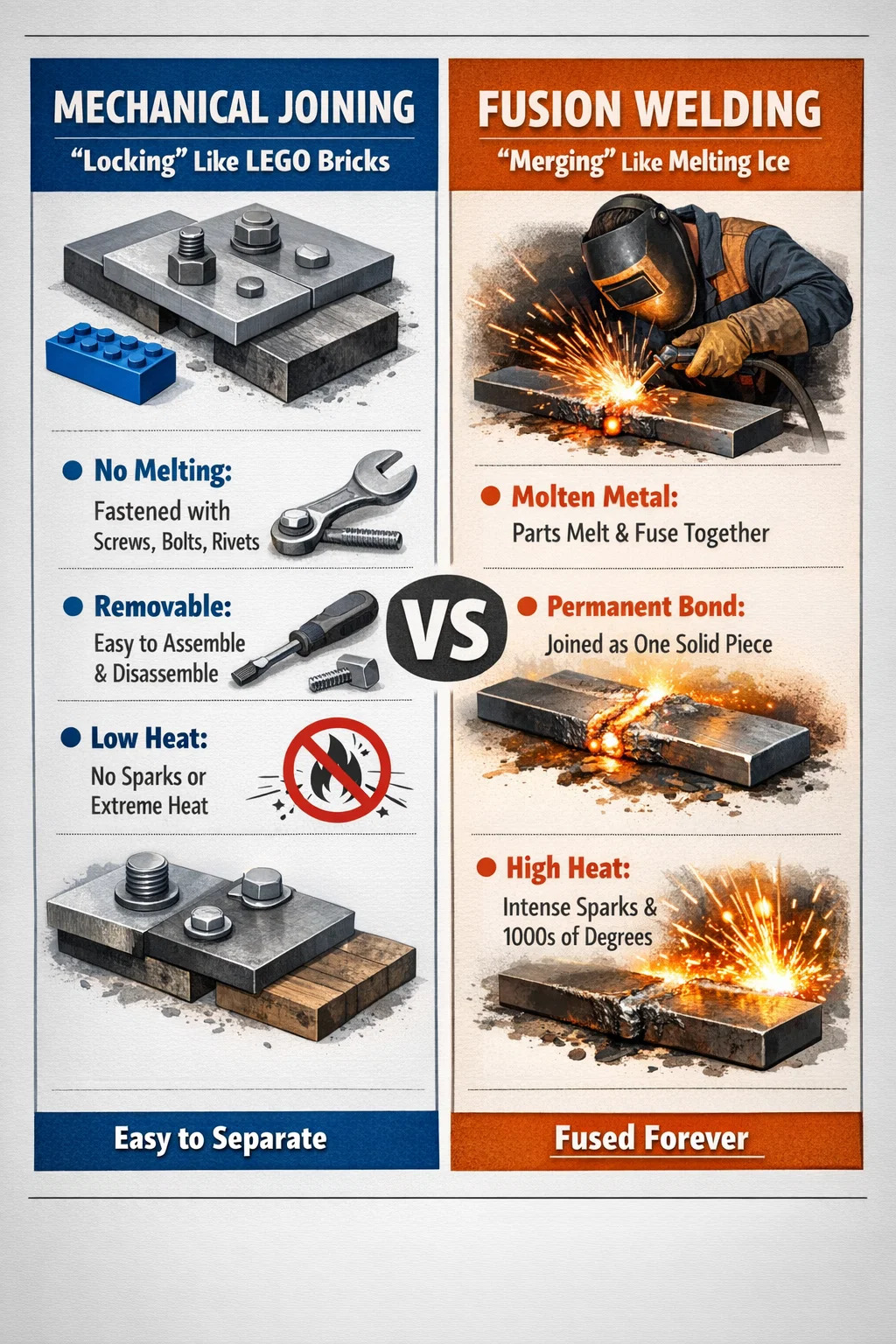
The core difference between these two methods lies in whether you are "sticking" or "locking" two things together, or "fusing" them into a single entity.
In industrial and everyday repairs, fusion welding and mechanical joining (usually referring to mechanical operations) are completely different approaches.
● Mechanical Joining: "Locking" like LEGO bricks
This method typically does not alter the properties of the materials themselves, relying primarily on physical force to secure the parts.
Physical binding: It uses screws, bolts, rivets, or compression and interlocking methods to prevent the two parts from moving. Like screwing a wooden board to a wall.
No melting involved: During the process, the metal does not become liquid. You only see tools striking, rotating, or compressing.
Removability: A major characteristic of mechanical joining is that it's "easy to assemble and disassemble." If you want to separate them, simply unscrew the screws or cut the rivets, and the parts usually retain their original shape.
Gentle environment: This type of operation usually doesn't produce blinding light or temperatures of thousands of degrees.
● Fusion Welding: "Merging" like melting ice
This is true "fusion," changing the state of the metal through high temperatures.
Molecular-level fusion: Fusion welding uses the high temperature generated by an electric arc or flame to directly melt the contact points of the two metals. The molten metals mix together, and after cooling and solidification, they become a single piece of metal.
Becoming one entity: After welding, it's difficult to distinguish where part A ends and part B begins, because they have grown together at the molecular level.
Permanence: This connection is permanent. Unless you cut the weld, they will never separate.
High-temperature operation: This is a typical hot work operation. There will be strong light (electric arc), sparks flying, and extremely high temperatures sufficient to instantly melt steel.